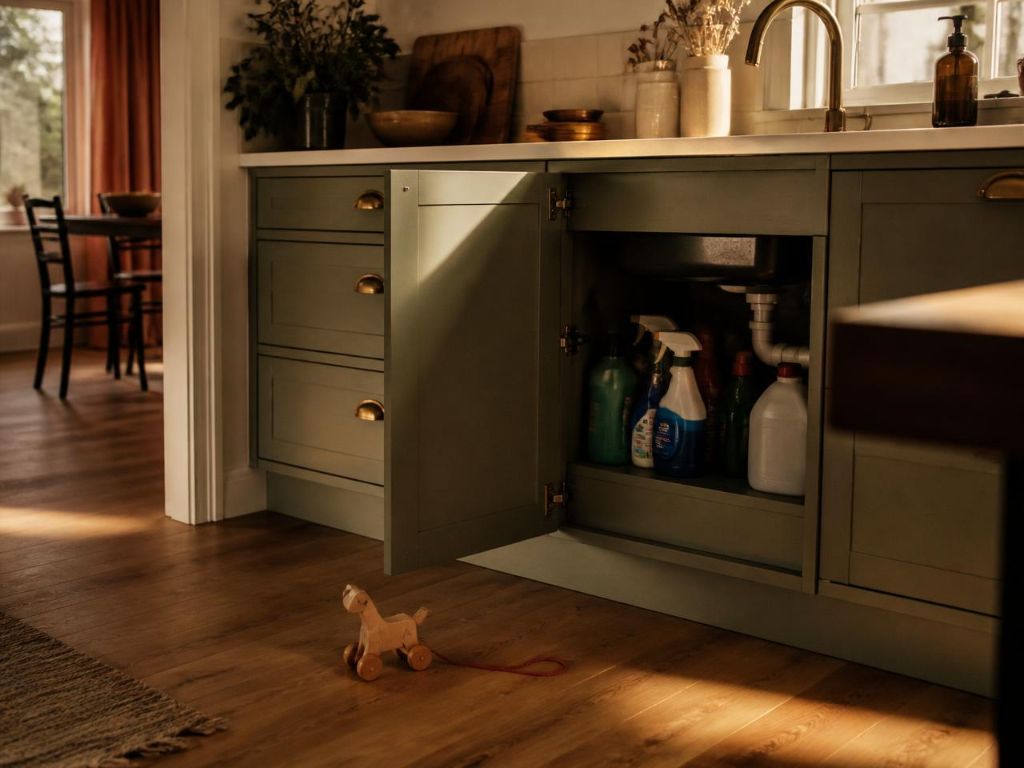
You cannot childproof every square inch of a home in a weekend, and trying to is how most parents end up doing nothing at all. The good news, buried in the data, is that you don’t have to. According to the 2024 Annual Report of America’s Poison Centers, pediatric poison exposures cluster heavily around a small number of specific locations. Three cabinets, in particular, account for more than 28% of childhood poisonings in America.
Lock those three first. Then, if you have time, do the rest. Here they are, in order of how often they show up in poison-control calls.
Cabinet 1 — Under the kitchen sink
This is the one. Cleaning products are consistently among the very top substances involved in pediatric exposures, and roughly 1 in 10 poison-control calls about a young child involves a household cleaner — many of them stored in the cabinet directly under the kitchen sink, at exactly toddler height, behind a door with no lock. Dishwasher pods are especially dangerous: they’re brightly colored, squishy, candy-sized, and concentrated.
The fix is not to move everything to a high shelf (you’ll stop doing it within a week). The fix is a magnetic cabinet lock: invisible from the outside, opened only with a magnetic key you keep on the fridge, installed with adhesive in about a minute per door.
You don’t need to childproof the whole house this weekend. You need to lock the cabinet under your kitchen sink today.
Cabinet 2 — The bathroom vanity (and the medicine cabinet)
The second cluster is medications. Analgesics — ordinary pain relievers like acetaminophen and ibuprofen — are perennially among the most common substances in pediatric exposure calls, and children’s vitamins with iron send a surprising number of toddlers to the ER. Two rules from the AAP and Poison Control matter most here:
- Up and away, and locked. Keep all medication in its original child-resistant container, high, out of sight, and behind a lock. “Child-resistant” is not “childproof” — it buys time, not immunity.
- Watch the purse and the nightstand. A huge share of medication poisonings involve a grandparent’s pill organizer, a visitor’s handbag, or a bottle left on a nightstand — not the locked cabinet. When guests visit, the bag goes up high.
Cabinet 3 — The laundry and garage shelf
The third is the one people forget because it isn’t in the kitchen: laundry detergent (again, especially single-load pods), plus the garage and utility shelves holding antifreeze, windshield fluid, pesticides, and automotive chemicals. Antifreeze is notoriously sweet-tasting and highly toxic in tiny amounts. Anything on a low garage shelf a toddler can reach belongs up high and, ideally, locked.
Recommended · Lock the cabinets
The one product that secures all three cabinets
Magnetic locks keep curious hands out of the under-sink, kitchen, and garage cabinets holding the highest-volume hazards. Adhesive install — no drilling required — and a 20-pack covers a whole home in a single afternoon.
Get the free Family Safety Checklist
A room-by-room hazard audit, the number to save in your phone right now, and the full home-safety routine — seven pages, no fluff.
No spam. Unsubscribe anytime.
The two-minute step that matters more than any lock
Before you install a single lock, do this: save the Poison Control number, 1-800-222-1222, in every phone in your house and post it on the fridge. It’s free, staffed 24/7 by experts, and the majority of calls are resolved at home without a costly ER trip. In a poisoning, the minutes before you get expert guidance are the ones that count — and fumbling to find the number is time you won’t have.
Beyond the three cabinets
Once the big three are locked, the next tier is quick: cover unused electrical outlets, anchor furniture and TVs to the wall (tip-overs injure a child roughly every 30 minutes in the U.S., per CPSC), and gate the stairs — hardware-mounted at the top, where a pressure-mounted gate can give way. None of it is glamorous. All of it is the quiet, unremarkable work that keeps ordinary days ordinary.